Devonshire
Barton Cottage
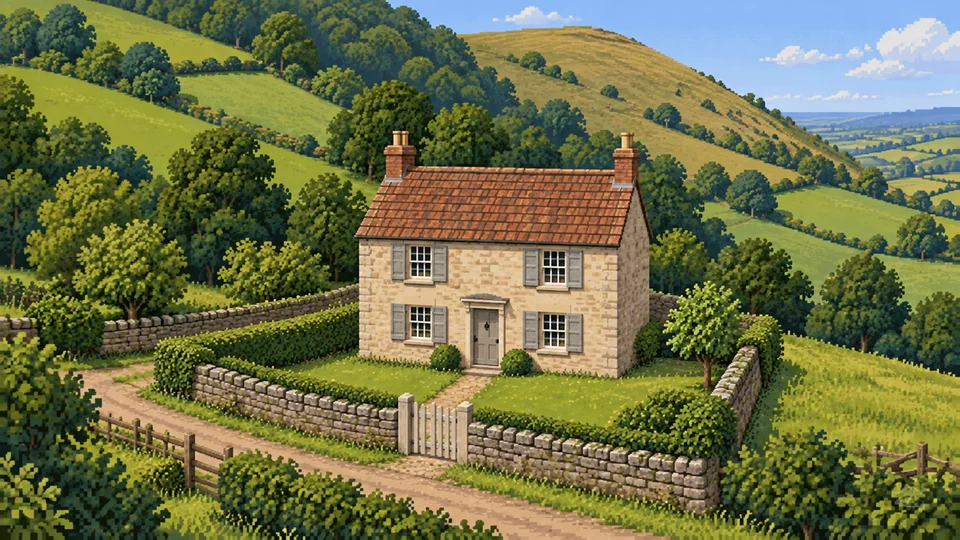
“it is too small for our family, but we will make ourselves tolerably comfortable for the present”Sense and Sensibility chapter 6
People

Elinor Dashwood
Sense and Sensibility
Elinor, this eldest daughter, whose advice was so effectual, possessed a strength of understanding, and coolness of judgment, which qualified her, though only nineteen, to be the counsellor of her mother, and enabled her frequently to counteract, to the advantage of them all, that eagerness of mind in Mrs. Dashwood which must generally have led to imprudence. …
Lives here. She moves there with her mother and sisters. Source

Margaret Dashwood
Sense and Sensibility
Margaret, the other sister, was a good-humored, well-disposed girl; but as she had already imbibed a good deal of Marianne’s romance, without having much of her sense, she did not, at thirteen, bid fair to equal her sisters at a more advanced period of life.
Lives here. She moves there with her mother and sisters. Source

Marianne Dashwood
Sense and Sensibility
Marianne’s abilities were, in many respects, quite equal to Elinor’s. She was sensible and clever; but eager in everything: her sorrows, her joys, could have no moderation. She was generous, amiable, interesting: she was everything but prudent. The resemblance between her and her mother was strikingly great.
Lives here. She moves there with her mother and sisters. Source

Mrs. Dashwood
Sense and Sensibility
Rents here. She takes the ready-furnished house for one year. Source
View all 7 illustrations
Austen’s description of Barton Cottage
As a house, Barton Cottage, though small, was comfortable and compact; but as a cottage it was defective, for the building was regular, the roof was tiled, the window shutters were not painted green, nor were the walls covered with honeysuckles. A narrow passage led directly through the house into the garden behind. On each side of the entrance was a sitting room, about sixteen feet square; and beyond them were the offices and the stairs. Four bed-rooms and two garrets formed the rest of the house. It had not been built many years and was in good repair. In comparison of Norland, it was poor and small indeed!—but the tears which recollection called forth as they entered the house were soon dried away. They were cheered by the joy of the servants on their arrival, and each for the sake of the others resolved to appear happy. It was very early in September; the season was fine, and from first seeing the place under the advantage of good weather, they received an impression in its favour which was of material service in recommending it to their lasting approbation.Sense and Sensibility chapter 6
“it is too small for our family, but we will make ourselves tolerably comfortable for the present”Sense and Sensibility chapter 6
The house
Mrs. Dashwood’s remarks suit the cottage’s compact size and modest exterior.
Original passage
An illustration combining details from Austen’s descriptions.
With the size and furniture of the house Mrs. Dashwood was upon the whole well satisfied; for though her former style of life rendered many additions to the latter indispensable, yet to add and improve was a delight to her; and she had at this time ready money enough to supply all that was wanted of greater elegance to the apartments. “As for the house itself, to be sure,” said she, “it is too small for our family, but we will make ourselves tolerably comfortable for the present, as it is too late in the year for improvements. Perhaps in the spring, if I have plenty of money, as I dare say I shall, we may think about building. These parlors are both too small for such parties of our friends as I hope to see often collected here; and I have some thoughts of throwing the passage into one of them with perhaps a part of the other, and so leave the remainder of that other for an entrance; this, with a new drawing room which may be easily added, and a bed-chamber and garret above, will make it a very snug little cottage. I could wish the stairs were handsome. But one must not expect every thing; though I suppose it would be no difficult matter to widen them. I shall see how much I am before-hand with the world in the spring, and we will plan our improvements accordingly.”
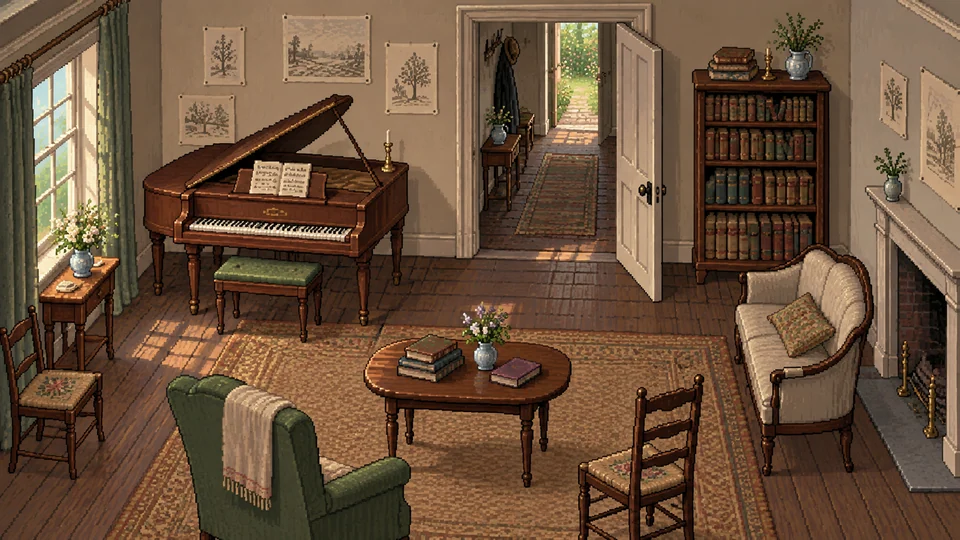
“Marianne’s pianoforte was unpacked and properly disposed of; and Elinor’s drawings were affixed to the walls of their sitting room.”Sense and Sensibility chapter 6
Inside the house
The sisters make the compact parlour their own with music and drawings.
Original passage
An illustration combining details from Austen’s descriptions.
In the mean time, till all these alterations could be made from the savings of an income of five hundred a-year by a woman who never saved in her life, they were wise enough to be contented with the house as it was; and each of them was busy in arranging their particular concerns, and endeavoring, by placing around them books and other possessions, to form themselves a home. Marianne’s pianoforte was unpacked and properly disposed of; and Elinor’s drawings were affixed to the walls of their sitting room.
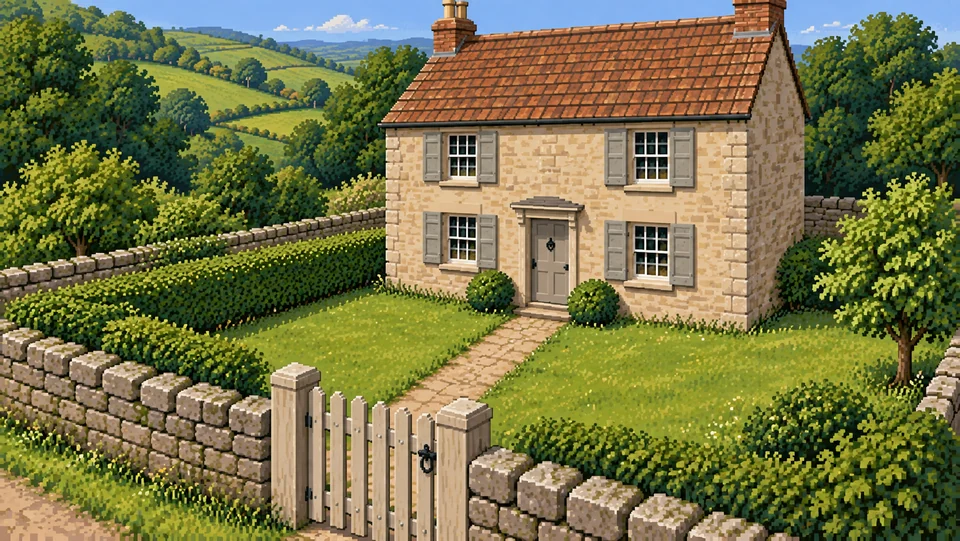
“A small green court was the whole of its demesne in front; and a neat wicket gate admitted them into it.”Sense and Sensibility chapter 6
Wicket-gate arrival
The neat wicket admits the Dashwoods into their very small front court.
Original passage
Illustrated from this passage.
The first part of their journey was performed in too melancholy a disposition to be otherwise than tedious and unpleasant. But as they drew towards the end of it, their interest in the appearance of a country which they were to inhabit overcame their dejection, and a view of Barton Valley as they entered it gave them cheerfulness. It was a pleasant fertile spot, well wooded, and rich in pasture. After winding along it for more than a mile, they reached their own house. A small green court was the whole of its demesne in front; and a neat wicket gate admitted them into it.
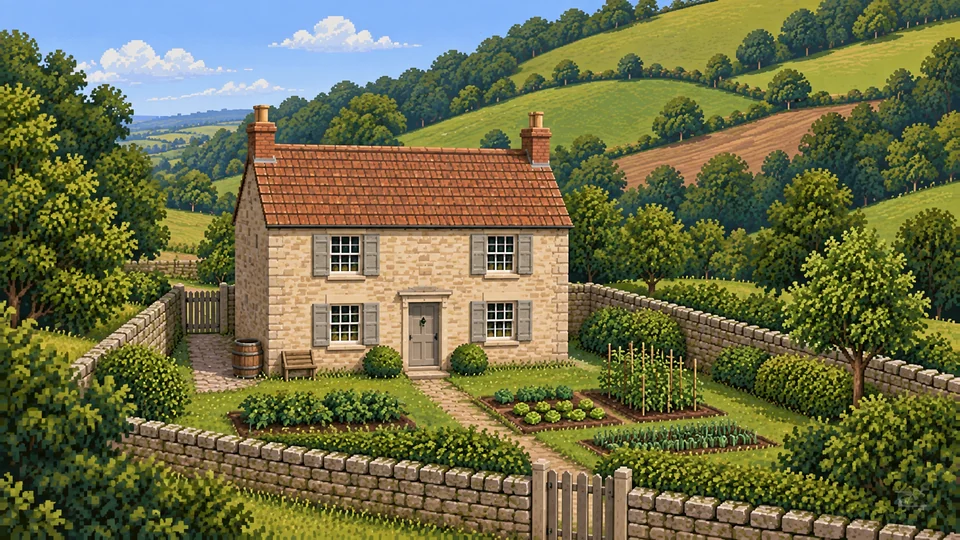
“High hills rose immediately behind, and at no great distance on each side; some of which were open downs, the others cultivated and woody.”Sense and Sensibility chapter 6
The garden
Barton Cottage sits below nearby hills, some open and others cultivated or wooded.
Original passage
An illustration combining details from Austen’s descriptions.
The situation of the house was good. High hills rose immediately behind, and at no great distance on each side; some of which were open downs, the others cultivated and woody. The village of Barton was chiefly on one of these hills, and formed a pleasant view from the cottage windows. The prospect in front was more extensive; it commanded the whole of the valley, and reached into the country beyond. The hills which surrounded the cottage terminated the valley in that direction; under another name, and in another course, it branched out again between two of the steepest of them.
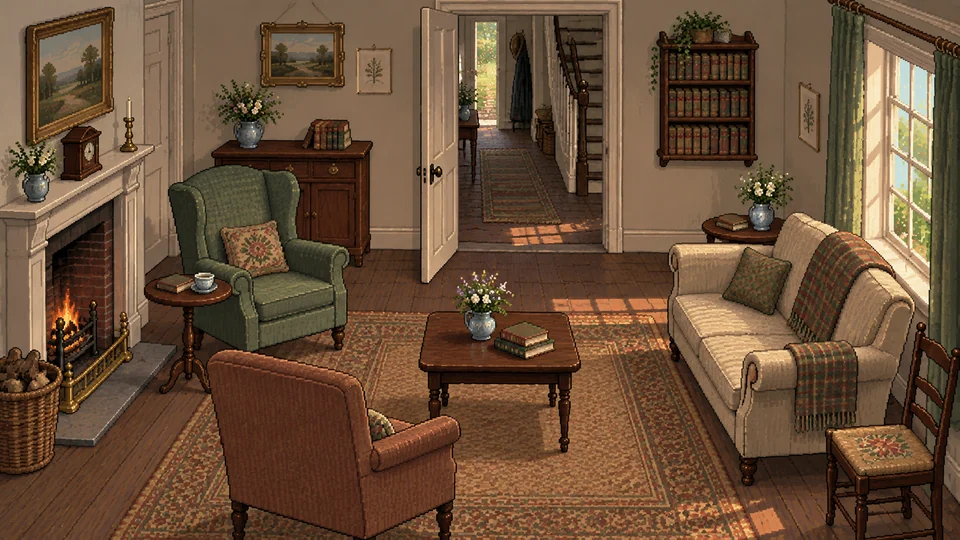
“this dear parlour in which our acquaintance first began, and in which so many happy hours have been since spent by us together”Sense and Sensibility chapter 14
Second sitting room
The familiar parlour holds the cottage’s remembered comfort and first acquaintance.
Original passage
An illustration combining details from Austen’s descriptions.
“How often did I wish,” added he, “when I was at Allenham this time twelvemonth, that Barton cottage were inhabited! I never passed within view of it without admiring its situation, and grieving that no one should live in it. How little did I then think that the very first news I should hear from Mrs. Smith, when I next came into the country, would be that Barton cottage was taken: and I felt an immediate satisfaction and interest in the event, which nothing but a kind of prescience of what happiness I should experience from it, can account for. Must it not have been so, Marianne?” speaking to her in a lowered voice. Then continuing his former tone, he said, “And yet this house you would spoil, Mrs. Dashwood? You would rob it of its simplicity by imaginary improvement! and this dear parlour in which our acquaintance first began, and in which so many happy hours have been since spent by us together, you would degrade to the condition of a common entrance, and every body would be eager to pass through the room which has hitherto contained within itself more real accommodation and comfort than any other apartment of the handsomest dimensions in the world could possibly afford.”
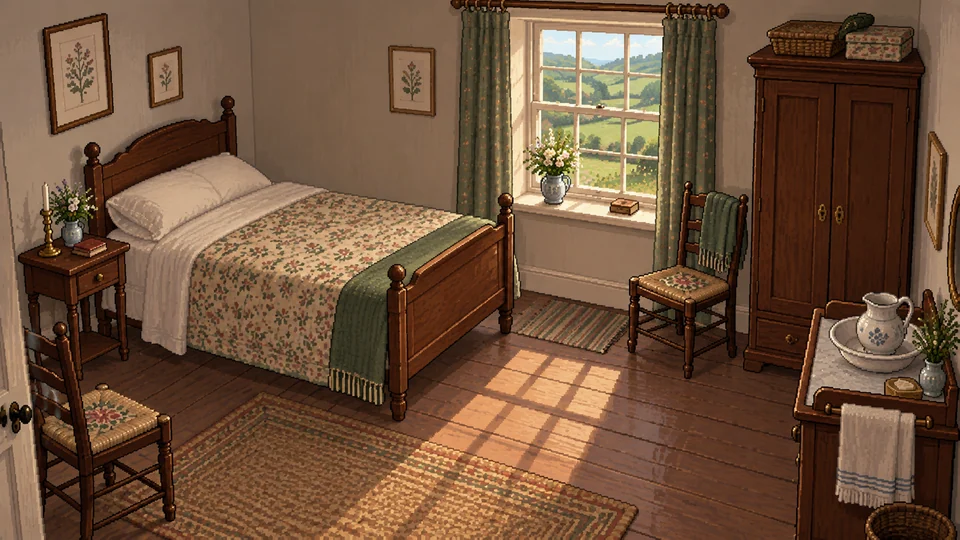
“Four bed-rooms and two garrets formed the rest of the house. It had not been built many years and was in good repair.”Sense and Sensibility chapter 6
Upper bedroom
The cottage’s upper rooms are modest, compact, and in good repair.
Original passage
An imagined view of a setting Austen leaves partly undescribed.
As a house, Barton Cottage, though small, was comfortable and compact; but as a cottage it was defective, for the building was regular, the roof was tiled, the window shutters were not painted green, nor were the walls covered with honeysuckles. A narrow passage led directly through the house into the garden behind. On each side of the entrance was a sitting room, about sixteen feet square; and beyond them were the offices and the stairs. Four bed-rooms and two garrets formed the rest of the house. It had not been built many years and was in good repair. In comparison of Norland, it was poor and small indeed!—but the tears which recollection called forth as they entered the house were soon dried away. They were cheered by the joy of the servants on their arrival, and each for the sake of the others resolved to appear happy. It was very early in September; the season was fine, and from first seeing the place under the advantage of good weather, they received an impression in its favour which was of material service in recommending it to their lasting approbation.
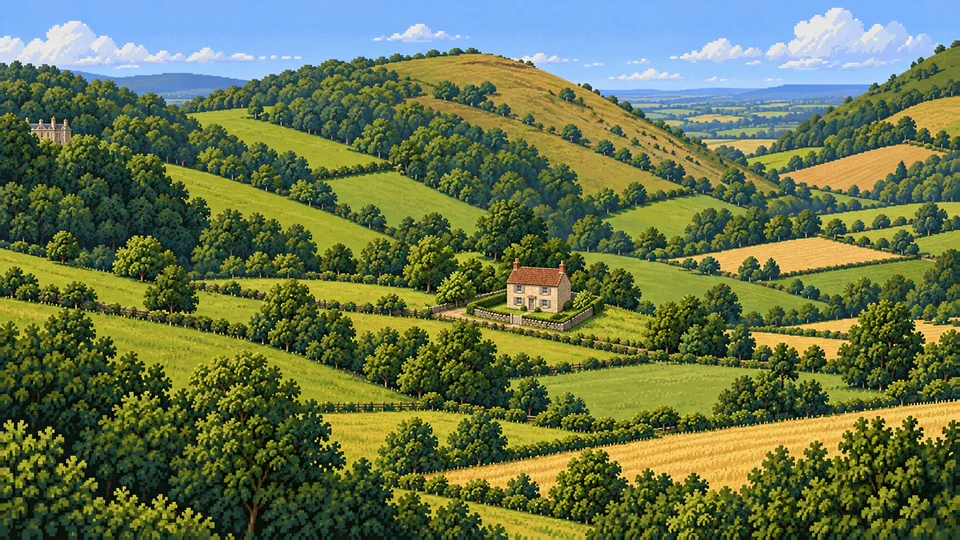
“To the left is Barton park, amongst those woods and plantations. You may see the end of the house. And there, beneath that farthest hill, which rises with such grandeur, is our cottage.”Sense and Sensibility chapter 16
In the valley
The cottage rests beneath the farthest hill, with Barton Park glimpsed at left.
Original passage
An illustration combining details from Austen’s descriptions.
“No; my feelings are not often shared, not often understood. But sometimes they are.”—As she said this, she sunk into a reverie for a few moments;—but rousing herself again, “Now, Edward,” said she, calling his attention to the prospect, “here is Barton valley. Look up to it, and be tranquil if you can. Look at those hills! Did you ever see their equals? To the left is Barton park, amongst those woods and plantations. You may see the end of the house. And there, beneath that farthest hill, which rises with such grandeur, is our cottage.”