Dorsetshire
Delaford

“His property here, his place, his house, every thing is in such respectable and excellent condition!”Sense and Sensibility chapter 50
View all 4 illustrations
Austen’s description of Delaford
“I will not say that I am disappointed, my dear sister,” said John, as they were walking together one morning before the gates of Delaford House, “that would be saying too much, for certainly you have been one of the most fortunate young women in the world, as it is. But, I confess, it would give me great pleasure to call Colonel Brandon brother. His property here, his place, his house, every thing is in such respectable and excellent condition! And his woods,—I have not seen such timber any where in Dorsetshire, as there is now standing in Delaford Hanger! And though, perhaps, Marianne may not seem exactly the person to attract him, yet I think it would altogether be advisable for you to have them now frequently staying with you, for as Colonel Brandon seems a great deal at home, nobody can tell what may happen; for, when people are much thrown together, and see little of anybody else,—and it will always be in your power to set her off to advantage, and so forth. In short, you may as well give her a chance: you understand me.”Sense and Sensibility chapter 50
“His property here, his place, his house, every thing is in such respectable and excellent condition!”Sense and Sensibility chapter 50
The house
The house and mature Dorset timber convey Delaford’s settled prosperity.
Original passage
An illustration combining details from Austen’s descriptions.
“I will not say that I am disappointed, my dear sister,” said John, as they were walking together one morning before the gates of Delaford House, “that would be saying too much, for certainly you have been one of the most fortunate young women in the world, as it is. But, I confess, it would give me great pleasure to call Colonel Brandon brother. His property here, his place, his house, every thing is in such respectable and excellent condition! And his woods,—I have not seen such timber any where in Dorsetshire, as there is now standing in Delaford Hanger! And though, perhaps, Marianne may not seem exactly the person to attract him, yet I think it would altogether be advisable for you to have them now frequently staying with you, for as Colonel Brandon seems a great deal at home, nobody can tell what may happen; for, when people are much thrown together, and see little of anybody else,—and it will always be in your power to set her off to advantage, and so forth. In short, you may as well give her a chance: you understand me.”
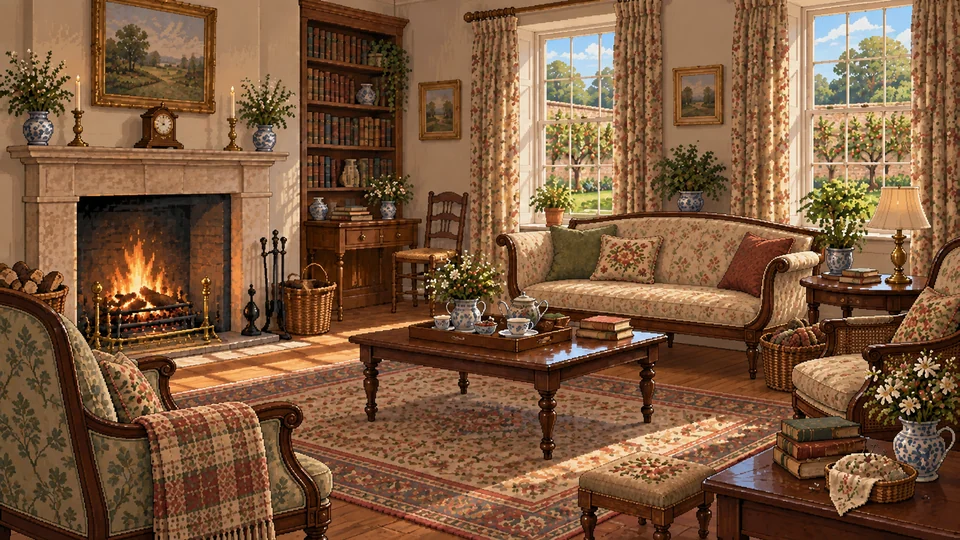
“Delaford is a nice place, I can tell you; exactly what I call a nice old fashioned place, full of comforts and conveniences”Sense and Sensibility chapter 30
Inside the house
The old-fashioned house is prized for comfort and convenience.
Original passage
An imagined view of a setting Austen leaves partly undescribed.
“Well, my dear, ’tis a true saying about an ill-wind, for it will be all the better for Colonel Brandon. He will have her at last; aye, that he will. Mind me, now, if they an’t married by Mid-summer. Lord! how he’ll chuckle over this news! I hope he will come tonight. It will be all to one a better match for your sister. Two thousand a year without debt or drawback—except the little love-child, indeed; aye, I had forgot her; but she may be ’prenticed out at a small cost, and then what does it signify? Delaford is a nice place, I can tell you; exactly what I call a nice old fashioned place, full of comforts and conveniences; quite shut in with great garden walls that are covered with the best fruit-trees in the country; and such a mulberry tree in one corner! Lord! how Charlotte and I did stuff the only time we were there! Then, there is a dove-cote, some delightful stew-ponds, and a very pretty canal; and every thing, in short, that one could wish for; and, moreover, it is close to the church, and only a quarter of a mile from the turnpike-road, so ’tis never dull, for if you only go and sit up in an old yew arbour behind the house, you may see all the carriages that pass along. Oh! ’tis a nice place! A butcher hard by in the village, and the parsonage-house within a stone’s throw. To my fancy, a thousand times prettier than Barton Park, where they are forced to send three miles for their meat, and have not a neighbour nearer than your mother. Well, I shall spirit up the Colonel as soon as I can. One shoulder of mutton, you know, drives another down. If we can but put Willoughby out of her head!”

“quite shut in with great garden walls that are covered with the best fruit-trees in the country; and such a mulberry tree in one corner!”Sense and Sensibility chapter 30
Walled fruit garden
Fruit-covered walls and a notable mulberry anchor Delaford’s garden.
Original passage
Illustrated from this passage.
“Well, my dear, ’tis a true saying about an ill-wind, for it will be all the better for Colonel Brandon. He will have her at last; aye, that he will. Mind me, now, if they an’t married by Mid-summer. Lord! how he’ll chuckle over this news! I hope he will come tonight. It will be all to one a better match for your sister. Two thousand a year without debt or drawback—except the little love-child, indeed; aye, I had forgot her; but she may be ’prenticed out at a small cost, and then what does it signify? Delaford is a nice place, I can tell you; exactly what I call a nice old fashioned place, full of comforts and conveniences; quite shut in with great garden walls that are covered with the best fruit-trees in the country; and such a mulberry tree in one corner! Lord! how Charlotte and I did stuff the only time we were there! Then, there is a dove-cote, some delightful stew-ponds, and a very pretty canal; and every thing, in short, that one could wish for; and, moreover, it is close to the church, and only a quarter of a mile from the turnpike-road, so ’tis never dull, for if you only go and sit up in an old yew arbour behind the house, you may see all the carriages that pass along. Oh! ’tis a nice place! A butcher hard by in the village, and the parsonage-house within a stone’s throw. To my fancy, a thousand times prettier than Barton Park, where they are forced to send three miles for their meat, and have not a neighbour nearer than your mother. Well, I shall spirit up the Colonel as soon as I can. One shoulder of mutton, you know, drives another down. If we can but put Willoughby out of her head!”

“Then, there is a dove-cote, some delightful stew-ponds, and a very pretty canal”Sense and Sensibility chapter 30
Canal and stew ponds
The dovecote, ponds, and canal reveal Delaford’s productive ornamental grounds.
Original passage
Illustrated from this passage.
“Well, my dear, ’tis a true saying about an ill-wind, for it will be all the better for Colonel Brandon. He will have her at last; aye, that he will. Mind me, now, if they an’t married by Mid-summer. Lord! how he’ll chuckle over this news! I hope he will come tonight. It will be all to one a better match for your sister. Two thousand a year without debt or drawback—except the little love-child, indeed; aye, I had forgot her; but she may be ’prenticed out at a small cost, and then what does it signify? Delaford is a nice place, I can tell you; exactly what I call a nice old fashioned place, full of comforts and conveniences; quite shut in with great garden walls that are covered with the best fruit-trees in the country; and such a mulberry tree in one corner! Lord! how Charlotte and I did stuff the only time we were there! Then, there is a dove-cote, some delightful stew-ponds, and a very pretty canal; and every thing, in short, that one could wish for; and, moreover, it is close to the church, and only a quarter of a mile from the turnpike-road, so ’tis never dull, for if you only go and sit up in an old yew arbour behind the house, you may see all the carriages that pass along. Oh! ’tis a nice place! A butcher hard by in the village, and the parsonage-house within a stone’s throw. To my fancy, a thousand times prettier than Barton Park, where they are forced to send three miles for their meat, and have not a neighbour nearer than your mother. Well, I shall spirit up the Colonel as soon as I can. One shoulder of mutton, you know, drives another down. If we can but put Willoughby out of her head!”