Surry
Donwell Abbey
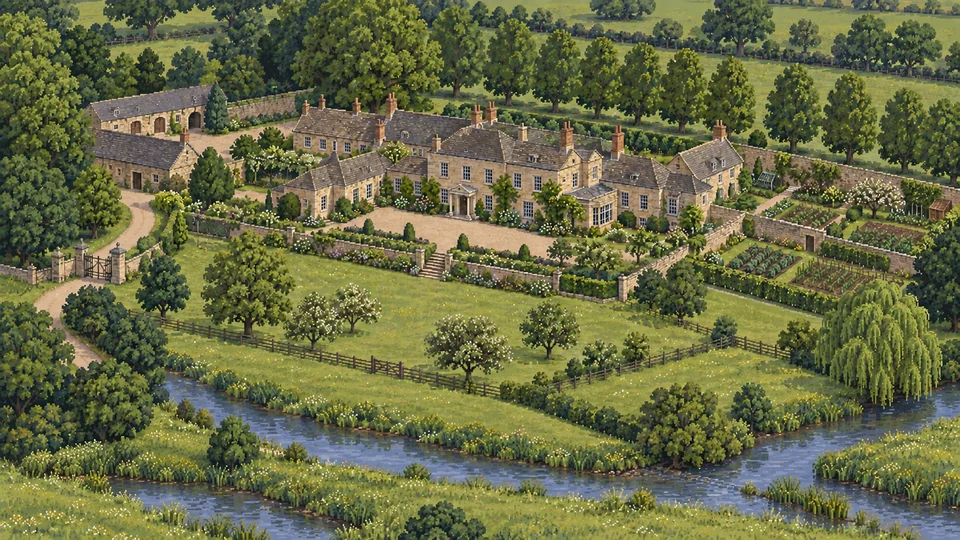
“its suitable, becoming, characteristic situation, low and sheltered—its ample gardens stretching down to meadows washed by a stream”Emma · Volume III, chapter 6
People

George Knightley
Emma
Mr. Knightley, a sensible man about seven or eight-and-thirty, was not only a very old and intimate friend of the family, but particularly connected with it, as the elder brother of Isabella’s husband. He lived about a mile from Highbury, was a frequent visitor, and always welcome, and at this time more welcome than usual, as coming directly from their mutual connexions in London. …
Lives here. The passage calls Donwell Abbey his seat. Source
View all 7 illustrations
Austen’s description of Donwell Abbey
She felt all the honest pride and complacency which her alliance with the present and future proprietor could fairly warrant, as she viewed the respectable size and style of the building, its suitable, becoming, characteristic situation, low and sheltered—its ample gardens stretching down to meadows washed by a stream, of which the Abbey, with all the old neglect of prospect, had scarcely a sight—and its abundance of timber in rows and avenues, which neither fashion nor extravagance had rooted up.—The house was larger than Hartfield, and totally unlike it, covering a good deal of ground, rambling and irregular, with many comfortable, and one or two handsome rooms.—It was just what it ought to be, and it looked what it was—and Emma felt an increasing respect for it, as the residence of a family of such true gentility, untainted in blood and understanding.—Some faults of temper John Knightley had; but Isabella had connected herself unexceptionably. She had given them neither men, nor names, nor places, that could raise a blush. These were pleasant feelings, and she walked about and indulged them till it was necessary to do as the others did, and collect round the strawberry-beds.—The whole party were assembled, excepting Frank Churchill, who was expected every moment from Richmond; and Mrs. Elton, in all her apparatus of happiness, her large bonnet and her basket, was very ready to lead the way in gathering, accepting, or talking—strawberries, and only strawberries, could now be thought or spoken of.—“The best fruit in England—every body’s favourite—always wholesome.—These the finest beds and finest sorts.—Delightful to gather for one’s self—the only way of really enjoying them.—Morning decidedly the best time—never tired—every sort good—hautboy infinitely superior—no comparison—the others hardly eatable—hautboys very scarce—Chili preferred—white wood finest flavour of all—price of strawberries in London—abundance about Bristol—Maple Grove—cultivation—beds when to be renewed—gardeners thinking exactly different—no general rule—gardeners never to be put out of their way—delicious fruit—only too rich to be eaten much of—inferior to cherries—currants more refreshing—only objection to gathering strawberries the stooping—glaring sun—tired to death—could bear it no longer—must go and sit in the shade.”Emma, Volume III, Chapter VI
“its suitable, becoming, characteristic situation, low and sheltered—its ample gardens stretching down to meadows washed by a stream”Emma · Volume III, chapter 6
The house
Donwell’s sheltered house sits above gardens descending toward stream-washed meadows.
Original passage
Illustrated from this passage.
She felt all the honest pride and complacency which her alliance with the present and future proprietor could fairly warrant, as she viewed the respectable size and style of the building, its suitable, becoming, characteristic situation, low and sheltered—its ample gardens stretching down to meadows washed by a stream, of which the Abbey, with all the old neglect of prospect, had scarcely a sight—and its abundance of timber in rows and avenues, which neither fashion nor extravagance had rooted up.—The house was larger than Hartfield, and totally unlike it, covering a good deal of ground, rambling and irregular, with many comfortable, and one or two handsome rooms.—It was just what it ought to be, and it looked what it was—and Emma felt an increasing respect for it, as the residence of a family of such true gentility, untainted in blood and understanding.—Some faults of temper John Knightley had; but Isabella had connected herself unexceptionably. She had given them neither men, nor names, nor places, that could raise a blush. These were pleasant feelings, and she walked about and indulged them till it was necessary to do as the others did, and collect round the strawberry-beds.—The whole party were assembled, excepting Frank Churchill, who was expected every moment from Richmond; and Mrs. Elton, in all her apparatus of happiness, her large bonnet and her basket, was very ready to lead the way in gathering, accepting, or talking—strawberries, and only strawberries, could now be thought or spoken of.—“The best fruit in England—every body’s favourite—always wholesome.—These the finest beds and finest sorts.—Delightful to gather for one’s self—the only way of really enjoying them.—Morning decidedly the best time—never tired—every sort good—hautboy infinitely superior—no comparison—the others hardly eatable—hautboys very scarce—Chili preferred—white wood finest flavour of all—price of strawberries in London—abundance about Bristol—Maple Grove—cultivation—beds when to be renewed—gardeners thinking exactly different—no general rule—gardeners never to be put out of their way—delicious fruit—only too rich to be eaten much of—inferior to cherries—currants more refreshing—only objection to gathering strawberries the stooping—glaring sun—tired to death—could bear it no longer—must go and sit in the shade.”
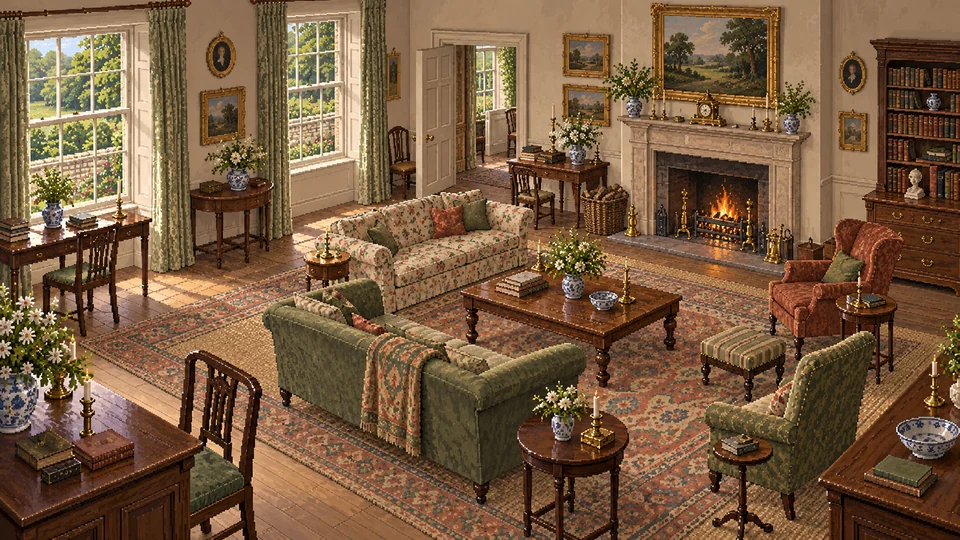
“in one of the most comfortable rooms in the Abbey, especially prepared for him by a fire all the morning”Emma · Volume III, chapter 6
Inside the house
A small fire keeps this Abbey reception room comfortable through midsummer.
Original passage
An illustration combining details from Austen’s descriptions.
Under a bright mid-day sun, at almost Midsummer, Mr. Woodhouse was safely conveyed in his carriage, with one window down, to partake of this al-fresco party; and in one of the most comfortable rooms in the Abbey, especially prepared for him by a fire all the morning, he was happily placed, quite at his ease, ready to talk with pleasure of what had been achieved, and advise every body to come and sit down, and not to heat themselves.—Mrs. Weston, who seemed to have walked there on purpose to be tired, and sit all the time with him, remained, when all the others were invited or persuaded out, his patient listener and sympathiser.
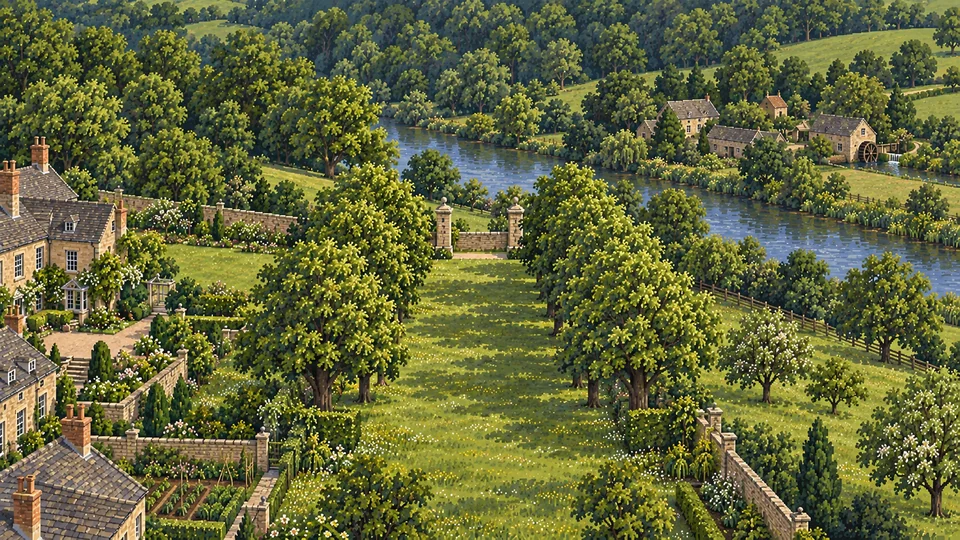
“a broad short avenue of limes, which stretching beyond the garden at an equal distance from the river, seemed the finish of the pleasure grounds”Emma · Volume III, chapter 6
Avenue terminus
The lime walk ends at a wall where a view replaces a true approach.
Original passage
Illustrated from this passage.
It was hot; and after walking some time over the gardens in a scattered, dispersed way, scarcely any three together, they insensibly followed one another to the delicious shade of a broad short avenue of limes, which stretching beyond the garden at an equal distance from the river, seemed the finish of the pleasure grounds.—It led to nothing; nothing but a view at the end over a low stone wall with high pillars, which seemed intended, in their erection, to give the appearance of an approach to the house, which never had been there. Disputable, however, as might be the taste of such a termination, it was in itself a charming walk, and the view which closed it extremely pretty.—The considerable slope, at nearly the foot of which the Abbey stood, gradually acquired a steeper form beyond its grounds; and at half a mile distant was a bank of considerable abruptness and grandeur, well clothed with wood;—and at the bottom of this bank, favourably placed and sheltered, rose the Abbey Mill Farm, with meadows in front, and the river making a close and handsome curve around it.
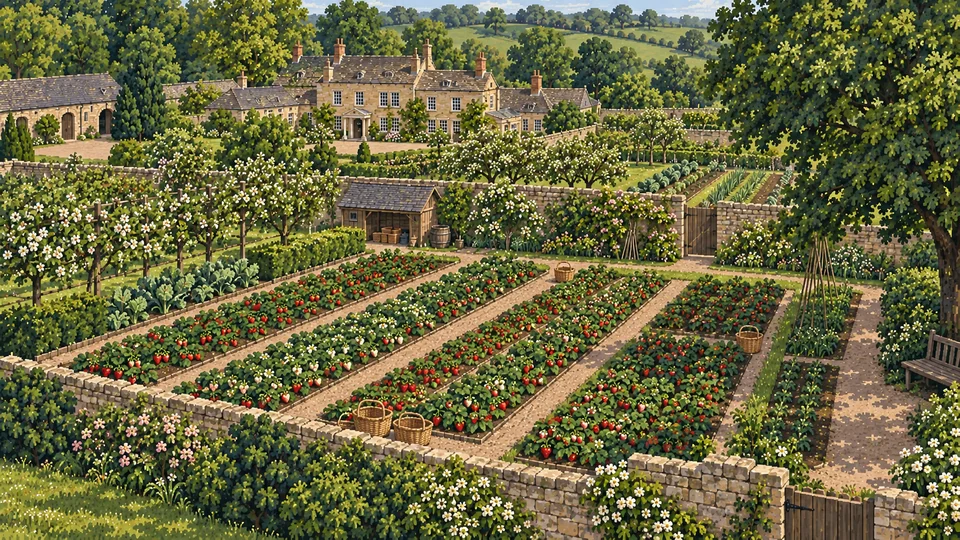
“Donwell was famous for its strawberry-beds, which seemed a plea for the invitation”Emma · Volume III, chapter 6
Strawberry garden
The celebrated strawberry beds make the kitchen garden a midsummer destination.
Original passage
An illustration combining details from Austen’s descriptions.
If Mr. Knightley did not begin seriously, he was obliged to proceed so, for his proposal was caught at with delight; and the “Oh! I should like it of all things,” was not plainer in words than manner. Donwell was famous for its strawberry-beds, which seemed a plea for the invitation: but no plea was necessary; cabbage-beds would have been enough to tempt the lady, who only wanted to be going somewhere. She promised him again and again to come—much oftener than he doubted—and was extremely gratified by such a proof of intimacy, such a distinguishing compliment as she chose to consider it.
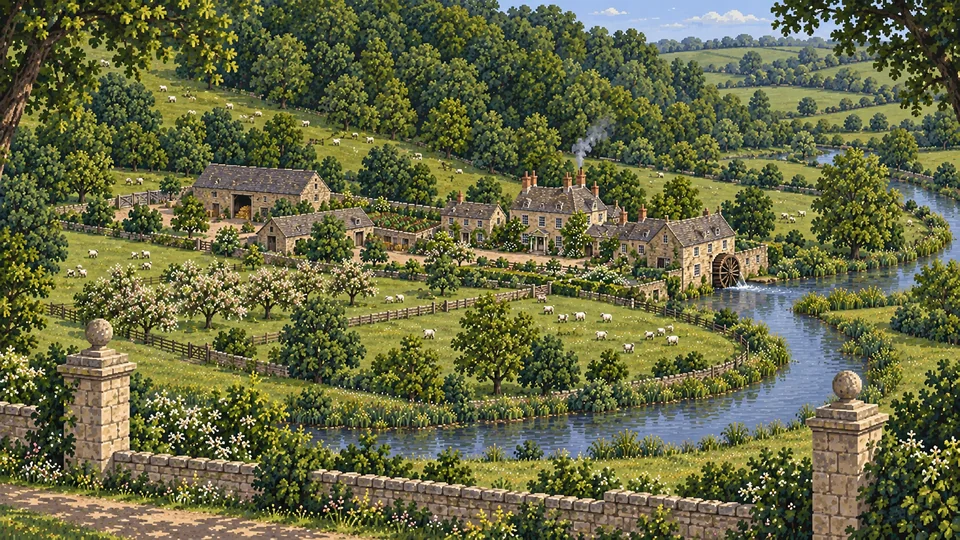
“all its appendages of prosperity and beauty, its rich pastures, spreading flocks, orchard in blossom, and light column of smoke ascending”Emma · Volume III, chapter 6
Abbey Mill Farm prospect
Pastures, flocks, blossom, and chimney smoke mark the farm below the Abbey.
Original passage
An illustration combining details from Austen’s descriptions.
In this walk Emma and Mr. Weston found all the others assembled; and towards this view she immediately perceived Mr. Knightley and Harriet distinct from the rest, quietly leading the way. Mr. Knightley and Harriet!—It was an odd tête-à-tête; but she was glad to see it.—There had been a time when he would have scorned her as a companion, and turned from her with little ceremony. Now they seemed in pleasant conversation. There had been a time also when Emma would have been sorry to see Harriet in a spot so favourable for the Abbey Mill Farm; but now she feared it not. It might be safely viewed with all its appendages of prosperity and beauty, its rich pastures, spreading flocks, orchard in blossom, and light column of smoke ascending.—She joined them at the wall, and found them more engaged in talking than in looking around. He was giving Harriet information as to modes of agriculture, etc. and Emma received a smile which seemed to say, “These are my own concerns. I have a right to talk on such subjects, without being suspected of introducing Robert Martin.”—She did not suspect him. It was too old a story.—Robert Martin had probably ceased to think of Harriet.—They took a few turns together along the walk.—The shade was most refreshing, and Emma found it the pleasantest part of the day.
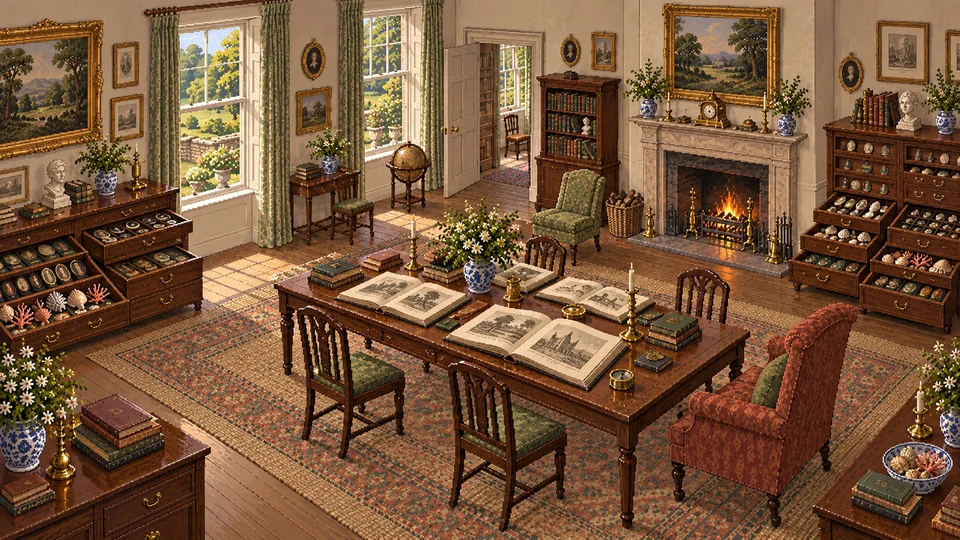
“Books of engravings, drawers of medals, cameos, corals, shells, and every other family collection within his cabinets, had been prepared for his old friend, to while away the morning”Emma · Volume III, chapter 6
Family collections
Prepared cabinets invite a slow morning with the family’s engravings and collections.
Original passage
Illustrated from this passage.
Mr. Knightley had done all in his power for Mr. Woodhouse’s entertainment. Books of engravings, drawers of medals, cameos, corals, shells, and every other family collection within his cabinets, had been prepared for his old friend, to while away the morning; and the kindness had perfectly answered. Mr. Woodhouse had been exceedingly well amused. Mrs. Weston had been shewing them all to him, and now he would shew them all to Emma;—fortunate in having no other resemblance to a child, than in a total want of taste for what he saw, for he was slow, constant, and methodical.—Before this second looking over was begun, however, Emma walked into the hall for the sake of a few moments’ free observation of the entrance and ground-plot of the house—and was hardly there, when Jane Fairfax appeared, coming quickly in from the garden, and with a look of escape.—Little expecting to meet Miss Woodhouse so soon, there was a start at first; but Miss Woodhouse was the very person she was in quest of.
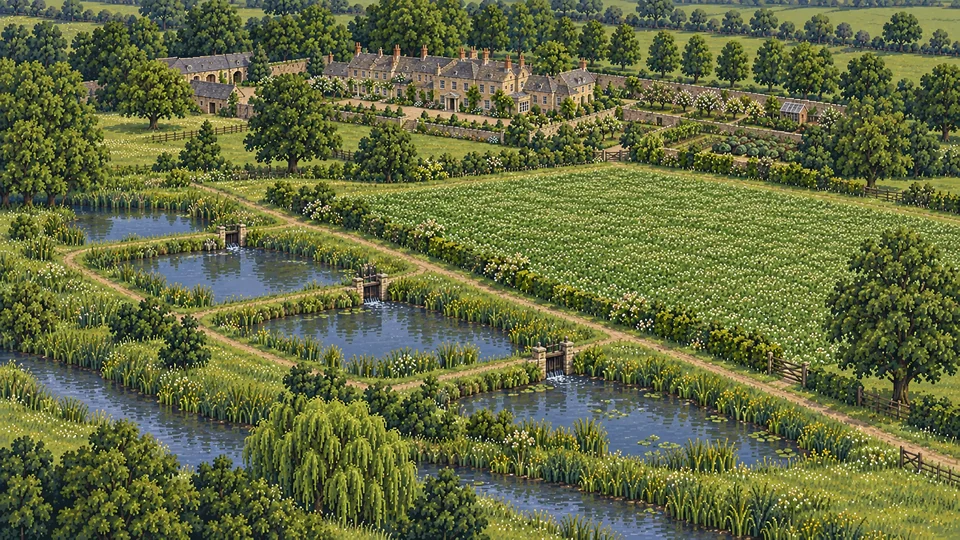
“the old Abbey fish-ponds; perhaps get as far as the clover, which was to be begun cutting on the morrow”Emma · Volume III, chapter 6
Fish ponds and working grounds
The old fish ponds and clover field extend Donwell’s working grounds beyond its gardens.
Original passage
Illustrated from this passage.
The cold repast was over, and the party were to go out once more to see what had not yet been seen, the old Abbey fish-ponds; perhaps get as far as the clover, which was to be begun cutting on the morrow, or, at any rate, have the pleasure of being hot, and growing cool again.—Mr. Woodhouse, who had already taken his little round in the highest part of the gardens, where no damps from the river were imagined even by him, stirred no more; and his daughter resolved to remain with him, that Mrs. Weston might be persuaded away by her husband to the exercise and variety which her spirits seemed to need.