Surry
Hartfield
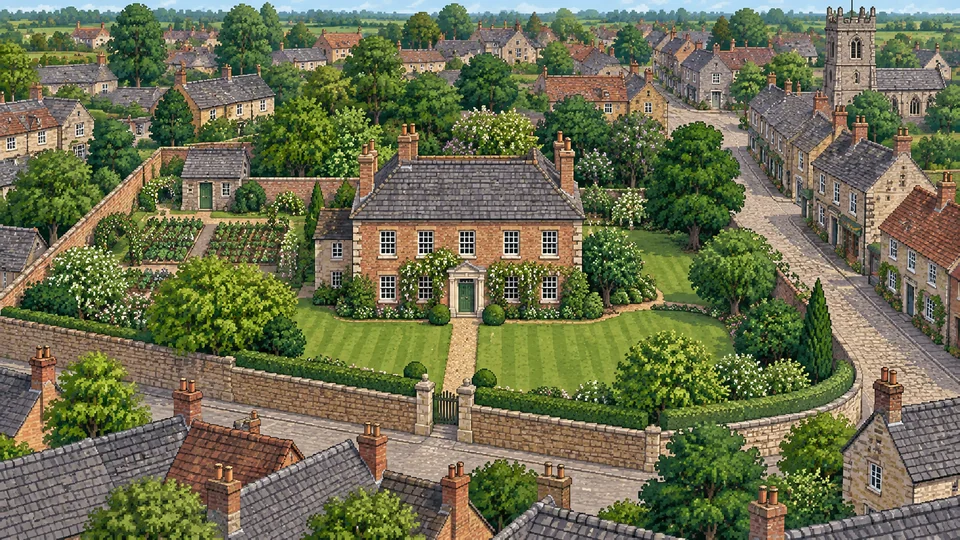
“Highbury, the large and populous village, almost amounting to a town, to which Hartfield, in spite of its separate lawn, and shrubberies, and name, did really belong”Emma · chapter 1
People

Emma Woodhouse
Emma
Emma Woodhouse, handsome, clever, and rich, with a comfortable home and happy disposition, seemed to unite some of the best blessings of existence; and had lived nearly twenty-one years in the world with very little to distress or vex her.
Lives here. Source

Mr. Woodhouse
Emma
Lives here. Source

Mrs. Weston
Emma
Sixteen years had Miss Taylor been in Mr. Woodhouse’s family, less as a governess than a friend, very fond of both daughters, but particularly of Emma. Between them it was more the intimacy of sisters. …
Lives here. Before marrying Mr. Weston; lived with the Woodhouses as governess and companion. Source

George Knightley
Emma
Mr. Knightley, a sensible man about seven or eight-and-thirty, was not only a very old and intimate friend of the family, but particularly connected with it, as the elder brother of Isabella’s husband. He lived about a mile from Highbury, was a frequent visitor, and always welcome, and at this time more welcome than usual, as coming directly from their mutual connexions in London. …
Visits. Frequent visitor; this visit follows his return from London. Source

Mr. Elton
Emma
“Mr. Elton is a very pretty young man, to be sure, and a very good young man, and I have a great regard for him. But if you want to shew him any attention, my dear, ask him to come and dine with us some day. That will be a much better thing. I dare say Mr. Knightley will be so kind as to meet him.”
Visits. Exchanges his otherwise vacant evenings for the company there. Source
View all 4 illustrations
Austen’s description of Hartfield
Highbury, the large and populous village, almost amounting to a town, to which Hartfield, in spite of its separate lawn, and shrubberies, and name, did really belong, afforded her no equals. The Woodhouses were first in consequence there. All looked up to them. She had many acquaintance in the place, for her father was universally civil, but not one among them who could be accepted in lieu of Miss Taylor for even half a day. It was a melancholy change; and Emma could not but sigh over it, and wish for impossible things, till her father awoke, and made it necessary to be cheerful. His spirits required support. He was a nervous man, easily depressed; fond of every body that he was used to, and hating to part with them; hating change of every kind. Matrimony, as the origin of change, was always disagreeable; and he was by no means yet reconciled to his own daughter’s marrying, nor could ever speak of her but with compassion, though it had been entirely a match of affection, when he was now obliged to part with Miss Taylor too; and from his habits of gentle selfishness, and of being never able to suppose that other people could feel differently from himself, he was very much disposed to think Miss Taylor had done as sad a thing for herself as for them, and would have been a great deal happier if she had spent all the rest of her life at Hartfield. Emma smiled and chatted as cheerfully as she could, to keep him from such thoughts; but when tea came, it was impossible for him not to say exactly as he had said at dinner,Emma, Volume I, Chapter I
“Highbury, the large and populous village, almost amounting to a town, to which Hartfield, in spite of its separate lawn, and shrubberies, and name, did really belong”Emma · chapter 1
The house
Hartfield’s own lawn and shrubberies remain part of bustling Highbury.
Original passage
An imagined view of a setting Austen leaves partly undescribed.
Highbury, the large and populous village, almost amounting to a town, to which Hartfield, in spite of its separate lawn, and shrubberies, and name, did really belong, afforded her no equals. The Woodhouses were first in consequence there. All looked up to them. She had many acquaintance in the place, for her father was universally civil, but not one among them who could be accepted in lieu of Miss Taylor for even half a day. It was a melancholy change; and Emma could not but sigh over it, and wish for impossible things, till her father awoke, and made it necessary to be cheerful. His spirits required support. He was a nervous man, easily depressed; fond of every body that he was used to, and hating to part with them; hating change of every kind. Matrimony, as the origin of change, was always disagreeable; and he was by no means yet reconciled to his own daughter’s marrying, nor could ever speak of her but with compassion, though it had been entirely a match of affection, when he was now obliged to part with Miss Taylor too; and from his habits of gentle selfishness, and of being never able to suppose that other people could feel differently from himself, he was very much disposed to think Miss Taylor had done as sad a thing for herself as for them, and would have been a great deal happier if she had spent all the rest of her life at Hartfield. Emma smiled and chatted as cheerfully as she could, to keep him from such thoughts; but when tea came, it was impossible for him not to say exactly as he had said at dinner,
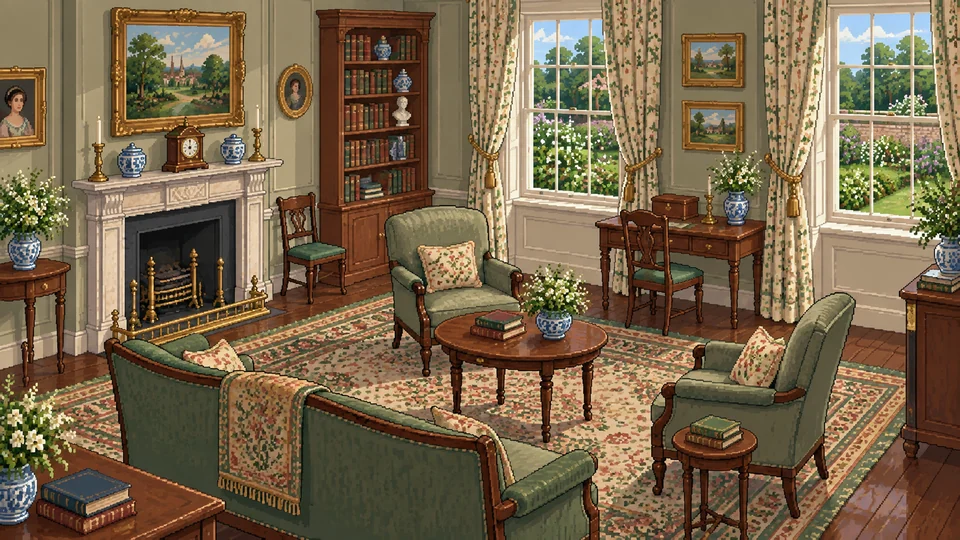
“A house of her own!—But where is the advantage of a house of her own? This is three times as large.”Emma · chapter 1
Inside the house
Mr. Woodhouse contrasts an independent home with Hartfield’s greater scale.
Original passage
An imagined view of a setting Austen leaves partly undescribed.
“A house of her own!—But where is the advantage of a house of her own? This is three times as large.—And you have never any odd humours, my dear.”

“where two divisions of the ground sufficed him for his long walk, or his short, as the year varied”Emma · chapter 4
Shrubbery circuit
Two paths divide Hartfield’s shrubbery into the father’s long and short walks.
Original passage
An illustration combining details from Austen’s descriptions.
Harriet Smith’s intimacy at Hartfield was soon a settled thing. Quick and decided in her ways, Emma lost no time in inviting, encouraging, and telling her to come very often; and as their acquaintance increased, so did their satisfaction in each other. As a walking companion, Emma had very early foreseen how useful she might find her. In that respect Mrs. Weston’s loss had been important. Her father never went beyond the shrubbery, where two divisions of the ground sufficed him for his long walk, or his short, as the year varied; and since Mrs. Weston’s marriage her exercise had been too much confined. She had ventured once alone to Randalls, but it was not pleasant; and a Harriet Smith, therefore, one whom she could summon at any time to a walk, would be a valuable addition to her privileges. But in every respect, as she saw more of her, she approved her, and was confirmed in all her kind designs.
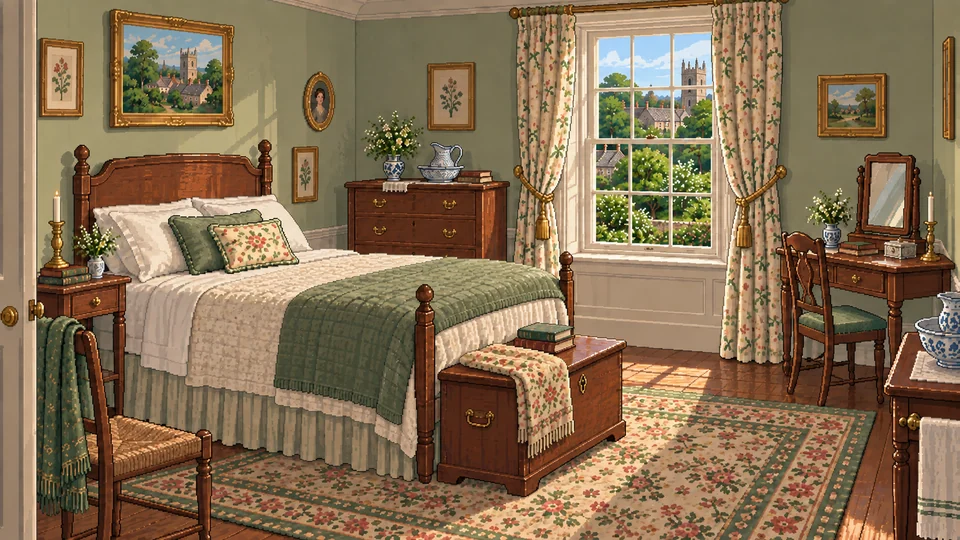
“she had been spending more than half her time there, and gradually getting to have a bed-room appropriated to herself”Emma · chapter 8
Guest bedroom
Frequent stays lead Harriet to claim a regular bedroom at Hartfield.
Original passage
Illustrated from this passage.
Harriet slept at Hartfield that night. For some weeks past she had been spending more than half her time there, and gradually getting to have a bed-room appropriated to herself; and Emma judged it best in every respect, safest and kindest, to keep her with them as much as possible just at present. She was obliged to go the next morning for an hour or two to Mrs. Goddard’s, but it was then to be settled that she should return to Hartfield, to make a regular visit of some days.