Gloucestershire
Northanger Abbey

“of its standing low in a valley, sheltered from the north and east by rising woods of oak”Northanger Abbey chapter 17
View all 10 illustrations
Austen’s description of Northanger Abbey
Many were the inquiries she was eager to make of Miss Tilney; but so active were her thoughts, that when these inquiries were answered, she was hardly more assured than before, of Northanger Abbey having been a richly endowed convent at the time of the Reformation, of its having fallen into the hands of an ancestor of the Tilneys on its dissolution, of a large portion of the ancient building still making a part of the present dwelling although the rest was decayed, or of its standing low in a valley, sheltered from the north and east by rising woods of oak.Northanger Abbey chapter 17
“of its standing low in a valley, sheltered from the north and east by rising woods of oak”Northanger Abbey chapter 17
The house
Ancient abbey fabric survives low in a valley beneath rising oak woods.
Original passage
An illustration combining details from Austen’s descriptions.
Many were the inquiries she was eager to make of Miss Tilney; but so active were her thoughts, that when these inquiries were answered, she was hardly more assured than before, of Northanger Abbey having been a richly endowed convent at the time of the Reformation, of its having fallen into the hands of an ancestor of the Tilneys on its dissolution, of a large portion of the ancient building still making a part of the present dwelling although the rest was decayed, or of its standing low in a valley, sheltered from the north and east by rising woods of oak.
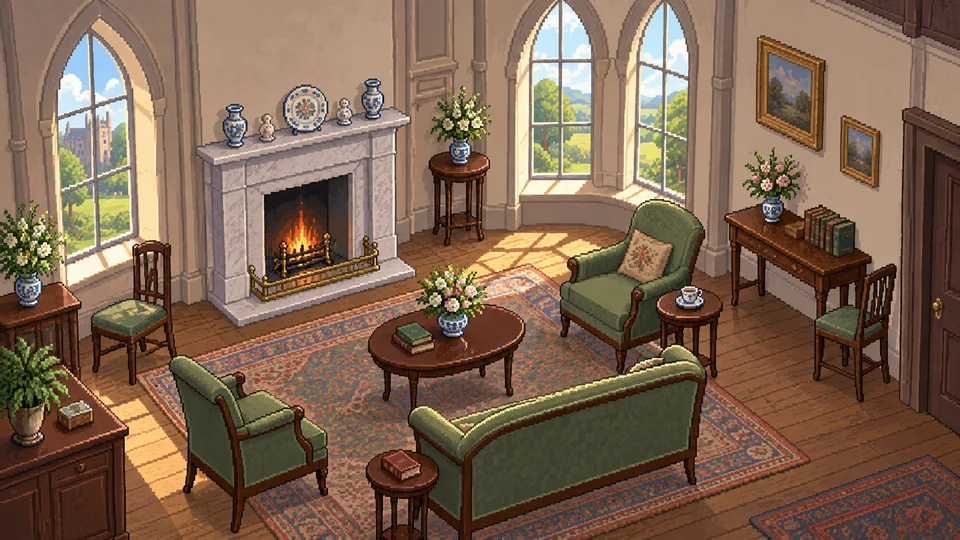
“but every pane was so large, so clear, so light!”Northanger Abbey chapter 20
Inside the house
The pointed Gothic windows admit clear light instead of Catherine’s imagined gloom.
Original passage
Illustrated from this passage.
An abbey! yes, it was delightful to be really in an abbey! but she doubted, as she looked round the room, whether anything within her observation would have given her the consciousness. The furniture was in all the profusion and elegance of modern taste. The fireplace, where she had expected the ample width and ponderous carving of former times, was contracted to a Rumford, with slabs of plain though handsome marble, and ornaments over it of the prettiest English china. The windows, to which she looked with peculiar dependence, from having heard the General talk of his preserving them in their Gothic form with reverential care, were yet less what her fancy had portrayed. To be sure, the pointed arch was preserved—the form of them was Gothic—they might be even casements—but every pane was so large, so clear, so light! to an imagination which had hoped for the smallest divisions, and the heaviest stone-work, for painted glass, dirt, and cobwebs, the difference was very distressing.

“to find herself with such ease in the very precincts of the abbey, and driven so rapidly along a smooth, level road of fine gravel, without obstacle, alarm, or solemnity of any kind”Northanger Abbey chapter 20
Lodge and gravel approach
Modern lodges and smooth gravel make the abbey approach unexpectedly ordinary.
Original passage
An illustration combining details from Austen’s descriptions.
She knew not that she had any right to be surprised, but there was a something in this mode of approach which she certainly had not expected. To pass between lodges of a modern appearance, to find herself with such ease in the very precincts of the abbey, and driven so rapidly along a smooth, level road of fine gravel, without obstacle, alarm, or solemnity of any kind, struck her as odd and inconsistent. She was not long at leisure, however, for such considerations. A sudden scud of rain, driving full in her face, made it impossible for her to observe anything further, and fixed all her thoughts on the welfare of her new straw bonnet; and she was actually under the abbey walls, was springing, with Henry’s assistance, from the carriage, was beneath the shelter of the old porch, and had even passed on to the hall, where her friend and the General were waiting to welcome her, without feeling one awful foreboding of future misery to herself, or one moment’s suspicion of any past scenes of horror being acted within the solemn edifice. The breeze had not seemed to waft the sighs of the murdered to her; it had wafted nothing worse than a thick mizzling rain; and having given a good shake to her habit, she was ready to be shown into the common drawing-room, and capable of considering where she was.

“The whole building enclosed a large court; and two sides of the quadrangle, rich in Gothic ornaments, stood forward for admiration.”Northanger Abbey chapter 22
Quadrangle
Gothic wings frame the enclosed court, with older woods beyond.
Original passage
An illustration combining details from Austen’s descriptions.
She was struck, however, beyond her expectation, by the grandeur of the abbey, as she saw it for the first time from the lawn. The whole building enclosed a large court; and two sides of the quadrangle, rich in Gothic ornaments, stood forward for admiration. The remainder was shut off by knolls of old trees, or luxuriant plantations, and the steep woody hills rising behind, to give it shelter, were beautiful even in the leafless month of March. Catherine had seen nothing to compare with it; and her feelings of delight were so strong, that without waiting for any better authority, she boldly burst forth in wonder and praise. The General listened with assenting gratitude; and it seemed as if his own estimation of Northanger had waited unfixed till that hour.

“The walls seemed countless in number, endless in length; a village of hot-houses seemed to arise among them”Northanger Abbey chapter 22
Kitchen garden and hot-houses
A seemingly endless walled garden holds a village of glass houses.
Original passage
Illustrated from this passage.
The number of acres contained in this garden was such as Catherine could not listen to without dismay, being more than double the extent of all Mr. Allen’s, as well as her father’s, including church-yard and orchard. The walls seemed countless in number, endless in length; a village of hot-houses seemed to arise among them, and a whole parish to be at work within the enclosure. The General was flattered by her looks of surprise, which told him almost as plainly, as he soon forced her to tell him in words, that she had never seen any gardens at all equal to them before; and he then modestly owned that, “without any ambition of that sort himself—without any solicitude about it—he did believe them to be unrivalled in the kingdom. If he had a hobby-horse, it was that. He loved a garden. Though careless enough in most matters of eating, he loved good fruit—or if he did not, his friends and children did. There were great vexations, however, attending such a garden as his. The utmost care could not always secure the most valuable fruits. The pinery had yielded only one hundred in the last year. Mr. Allen, he supposed, must feel these inconveniences as well as himself.”
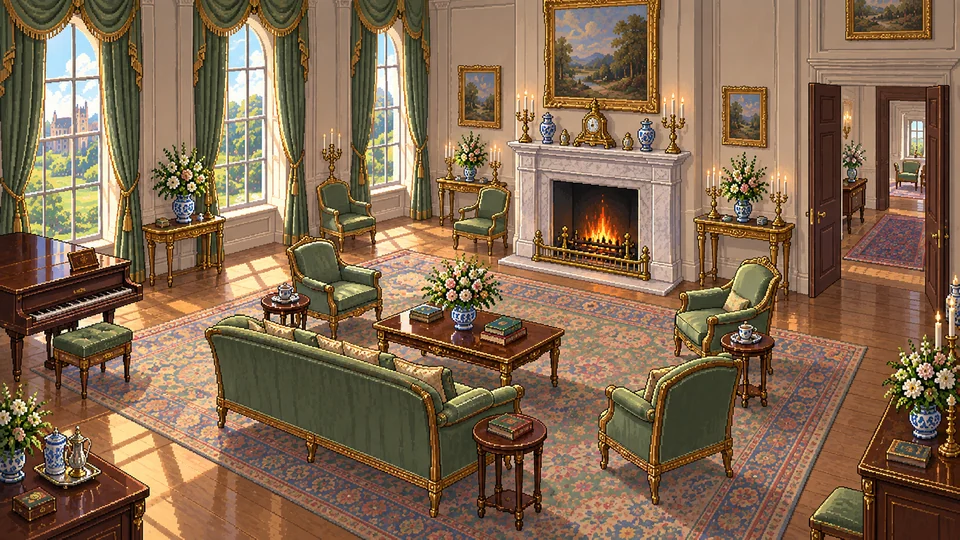
“into a room magnificent both in size and furniture—the real drawing-room, used only with company of consequence”Northanger Abbey chapter 23
Great drawing room
The formal drawing room is reserved for distinguished company and ceremonial visits.
Original passage
Illustrated from this passage.
They set forward; and, with a grandeur of air, a dignified step, which caught the eye, but could not shake the doubts of the well-read Catherine, he led the way across the hall, through the common drawing-room and one useless antechamber, into a room magnificent both in size and furniture—the real drawing-room, used only with company of consequence. It was very noble—very grand—very charming!—was all that Catherine had to say, for her indiscriminating eye scarcely discerned the colour of the satin; and all minuteness of praise, all praise that had much meaning, was supplied by the General: the costliness or elegance of any room’s fitting-up could be nothing to her; she cared for no furniture of a more modern date than the fifteenth century. When the General had satisfied his own curiosity, in a close examination of every well-known ornament, they proceeded into the library, an apartment, in its way, of equal magnificence, exhibiting a collection of books, on which an humble man might have looked with pride. Catherine heard, admired, and wondered with more genuine feeling than before—gathered all that she could from this storehouse of knowledge, by running over the titles of half a shelf, and was ready to proceed. But suites of apartments did not spring up with her wishes. Large as was the building, she had already visited the greatest part; though, on being told that, with the addition of the kitchen, the six or seven rooms she had now seen surrounded three sides of the court, she could scarcely believe it, or overcome the suspicion of there being many chambers secreted. It was some relief, however, that they were to return to the rooms in common use, by passing through a few of less importance, looking into the court, which, with occasional passages, not wholly unintricate, connected the different sides; and she was further soothed in her progress by being told that she was treading what had once been a cloister, having traces of cells pointed out, and observing several doors that were neither opened nor explained to her—by finding herself successively in a billiard-room, and in the General’s private apartment, without comprehending their connection, or being able to turn aright when she left them; and lastly, by passing through a dark little room, owning Henry’s authority, and strewed with his litter of books, guns, and greatcoats.
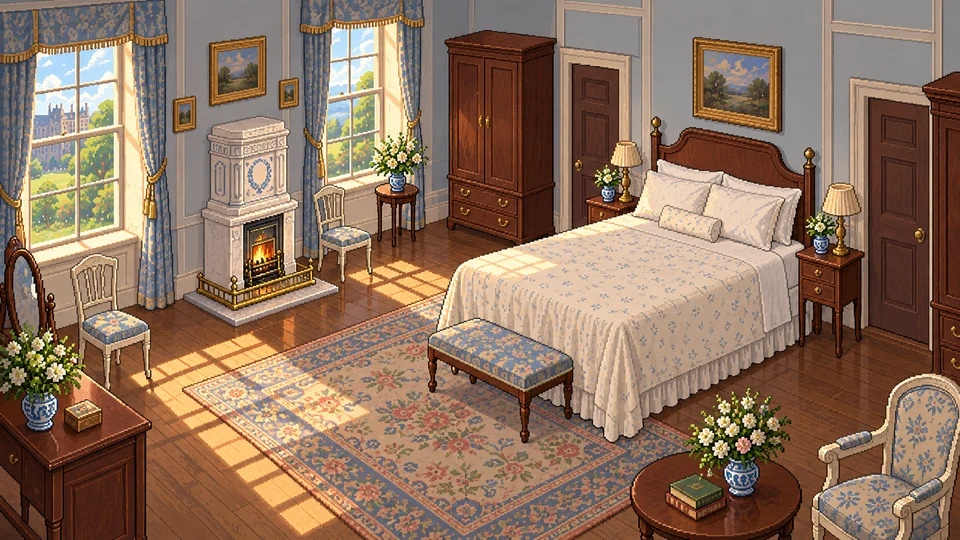
“a large, well-proportioned apartment, an handsome dimity bed, arranged as unoccupied with an housemaid’s care, a bright Bath stove, mahogany wardrobes, and neatly painted chairs”Northanger Abbey chapter 24
West-lit bedchamber
The carefully kept bedchamber joins handsome furnishings with ordinary comfort.
Original passage
Illustrated from this passage.
It was done; and Catherine found herself alone in the gallery before the clocks had ceased to strike. It was no time for thought; she hurried on, slipped with the least possible noise through the folding doors, and without stopping to look or breathe, rushed forward to the one in question. The lock yielded to her hand, and, luckily, with no sullen sound that could alarm a human being. On tiptoe she entered; the room was before her; but it was some minutes before she could advance another step. She beheld what fixed her to the spot and agitated every feature. She saw a large, well-proportioned apartment, an handsome dimity bed, arranged as unoccupied with an housemaid’s care, a bright Bath stove, mahogany wardrobes, and neatly painted chairs, on which the warm beams of a western sun gaily poured through two sash windows! Catherine had expected to have her feelings worked, and worked they were. Astonishment and doubt first seized them; and a shortly succeeding ray of common sense added some bitter emotions of shame. She could not be mistaken as to the room; but how grossly mistaken in everything else!—in Miss Tilney’s meaning, in her own calculation! this apartment, to which she had given a date so ancient, a position so awful, proved to be one end of what the General’s father had built. There were two other doors in the chamber, leading probably into dressing-closets; but she had no inclination to open either. Would the veil in which Mrs. Tilney had last walked, or the volume in which she had last read, remain to tell what nothing else was allowed to whisper? No: whatever might have been the General’s crimes, he had certainly too much wit to let them sue for detection. She was sick of exploring, and desired but to be safe in her own room, with her own heart only privy to its folly; and she was on the point of retreating as softly as she had entered, when the sound of footsteps, she could hardly tell where, made her pause and tremble. To be found there, even by a servant, would be unpleasant; but by the General (and he seemed always at hand when least wanted), much worse! she listened—the sound had ceased; and resolving not to lose a moment, she passed through and closed the door. At that instant a door underneath was hastily opened; someone seemed with swift steps to ascend the stairs, by the head of which she had yet to pass before she could gain the gallery. She had no power to move. With a feeling of terror not very definable, she fixed her eyes on the staircase, and in a few moments it gave Henry to her view. “Mr. Tilney!” she exclaimed in a voice of more than common astonishment. He looked astonished too. “Good God!” she continued, not attending to his address. “How came you here? How came you up that staircase?”
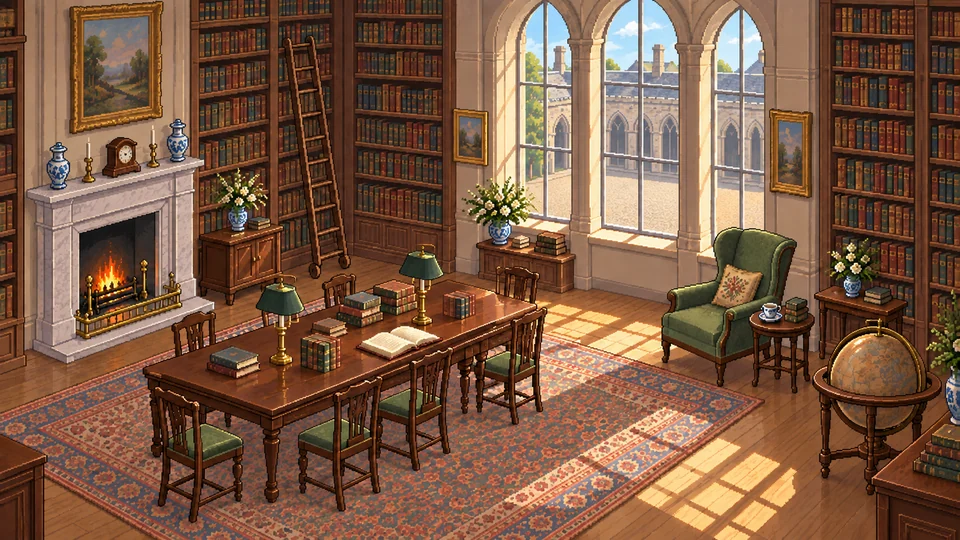
“an apartment, in its way, of equal magnificence, exhibiting a collection of books, on which an humble man might have looked with pride”Northanger Abbey chapter 23
Library
Northanger’s library pairs a substantial book collection with an imposing room.
Original passage
Illustrated from this passage.
They set forward; and, with a grandeur of air, a dignified step, which caught the eye, but could not shake the doubts of the well-read Catherine, he led the way across the hall, through the common drawing-room and one useless antechamber, into a room magnificent both in size and furniture—the real drawing-room, used only with company of consequence. It was very noble—very grand—very charming!—was all that Catherine had to say, for her indiscriminating eye scarcely discerned the colour of the satin; and all minuteness of praise, all praise that had much meaning, was supplied by the General: the costliness or elegance of any room’s fitting-up could be nothing to her; she cared for no furniture of a more modern date than the fifteenth century. When the General had satisfied his own curiosity, in a close examination of every well-known ornament, they proceeded into the library, an apartment, in its way, of equal magnificence, exhibiting a collection of books, on which an humble man might have looked with pride. Catherine heard, admired, and wondered with more genuine feeling than before—gathered all that she could from this storehouse of knowledge, by running over the titles of half a shelf, and was ready to proceed. But suites of apartments did not spring up with her wishes. Large as was the building, she had already visited the greatest part; though, on being told that, with the addition of the kitchen, the six or seven rooms she had now seen surrounded three sides of the court, she could scarcely believe it, or overcome the suspicion of there being many chambers secreted. It was some relief, however, that they were to return to the rooms in common use, by passing through a few of less importance, looking into the court, which, with occasional passages, not wholly unintricate, connected the different sides; and she was further soothed in her progress by being told that she was treading what had once been a cloister, having traces of cells pointed out, and observing several doors that were neither opened nor explained to her—by finding herself successively in a billiard-room, and in the General’s private apartment, without comprehending their connection, or being able to turn aright when she left them; and lastly, by passing through a dark little room, owning Henry’s authority, and strewed with his litter of books, guns, and greatcoats.
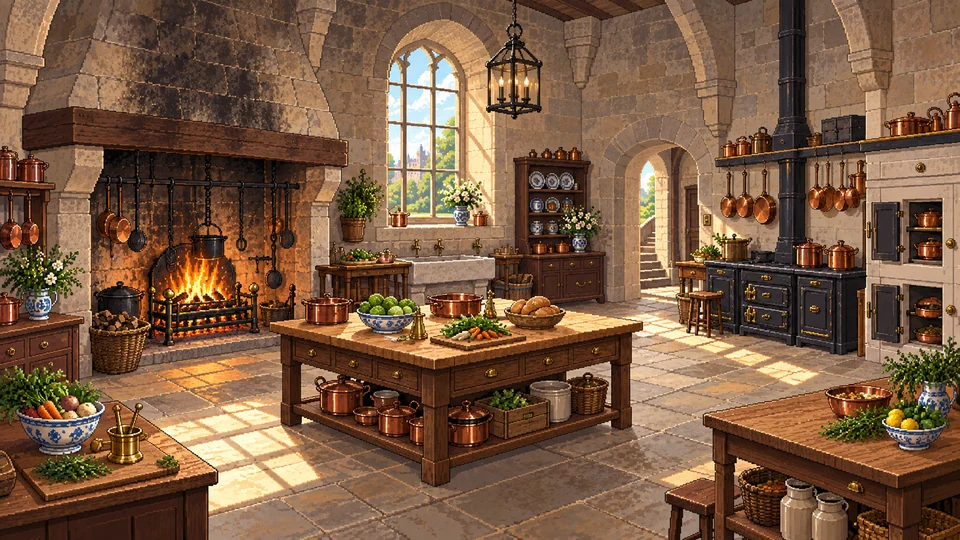
“the ancient kitchen of the convent, rich in the massy walls and smoke of former days, and in the stoves and hot closets of the present”Northanger Abbey chapter 23
Ancient kitchen and modern equipment
Massive convent walls and modern stoves meet in the working kitchen.
Original passage
Illustrated from this passage.
From the dining-room, of which, though already seen, and always to be seen at five o’clock, the General could not forgo the pleasure of pacing out the length, for the more certain information of Miss Morland, as to what she neither doubted nor cared for, they proceeded by quick communication to the kitchen—the ancient kitchen of the convent, rich in the massy walls and smoke of former days, and in the stoves and hot closets of the present. The General’s improving hand had not loitered here: every modern invention to facilitate the labour of the cooks had been adopted within this, their spacious theatre; and, when the genius of others had failed, his own had often produced the perfection wanted. His endowments of this spot alone might at any time have placed him high among the benefactors of the convent.

“The new building was not only new, but declared itself to be so; intended only for offices, and enclosed behind by stable-yards, no uniformity of architecture had been thought necessary.”Northanger Abbey chapter 23
Office range and stable yards
The newer service range favors useful offices and stable yards over matching Gothic design.
Original passage
Illustrated from this passage.
With the walls of the kitchen ended all the antiquity of the abbey; the fourth side of the quadrangle having, on account of its decaying state, been removed by the General’s father, and the present erected in its place. All that was venerable ceased here. The new building was not only new, but declared itself to be so; intended only for offices, and enclosed behind by stable-yards, no uniformity of architecture had been thought necessary. Catherine could have raved at the hand which had swept away what must have been beyond the value of all the rest, for the purposes of mere domestic economy; and would willingly have been spared the mortification of a walk through scenes so fallen, had the General allowed it; but if he had a vanity, it was in the arrangement of his offices; and as he was convinced that, to a mind like Miss Morland’s, a view of the accommodations and comforts by which the labours of her inferiors were softened, must always be gratifying, he should make no apology for leading her on. They took a slight survey of all; and Catherine was impressed, beyond her expectation, by their multiplicity and their convenience. The purposes for which a few shapeless pantries and a comfortless scullery were deemed sufficient at Fullerton, were here carried on in appropriate divisions, commodious and roomy. The number of servants continually appearing did not strike her less than the number of their offices. Wherever they went, some pattened girl stopped to curtsy, or some footman in dishabille sneaked off. Yet this was an abbey! how inexpressibly different in these domestic arrangements from such as she had read about—from abbeys and castles, in which, though certainly larger than Northanger, all the dirty work of the house was to be done by two pair of female hands at the utmost. How they could get through it all had often amazed Mrs. Allen; and, when Catherine saw what was necessary here, she began to be amazed herself.