Surry
Randalls
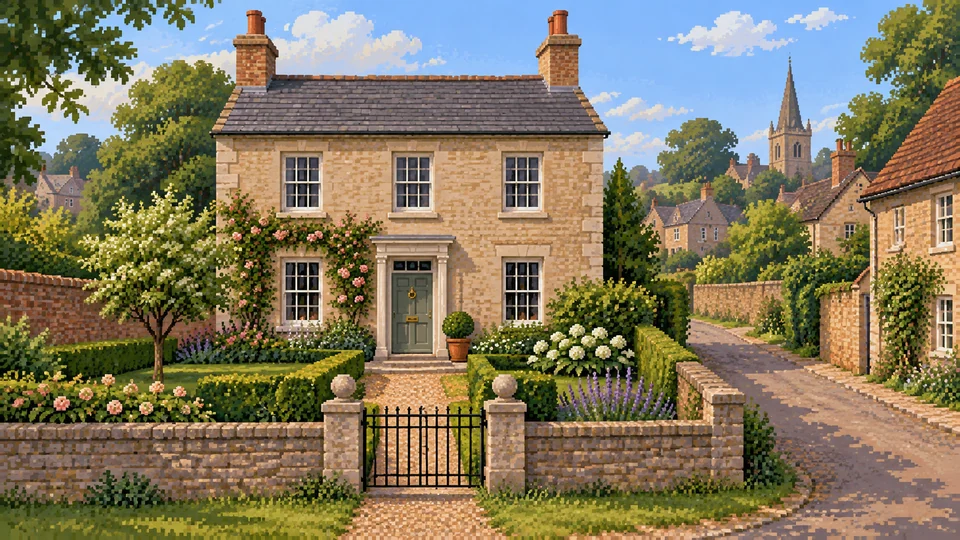
“He was very much pleased with Randalls, thought it a most admirably arranged house, would hardly allow it even to be very small”Emma · Volume II, chapter 5
People

Mr. Weston
Emma
Mr. Weston was a native of Highbury, and born of a respectable family, which for the last two or three generations had been rising into gentility and property. He had received a good education, but, on succeeding early in life to a small independence, had become indisposed for any of the more homely pursuits in which his brothers were engaged, and had satisfied an active, cheerful mind and social temper by entering into the militia of his county, then embodied.

Mrs. Weston
Emma
Sixteen years had Miss Taylor been in Mr. Woodhouse’s family, less as a governess than a friend, very fond of both daughters, but particularly of Emma. Between them it was more the intimacy of sisters. …
View all 3 illustrations
Austen’s description of Randalls
The word home made his father look on him with fresh complacency. Emma was directly sure that he knew how to make himself agreeable; the conviction was strengthened by what followed. He was very much pleased with Randalls, thought it a most admirably arranged house, would hardly allow it even to be very small, admired the situation, the walk to Highbury, Highbury itself, Hartfield still more, and professed himself to have always felt the sort of interest in the country which none but one’s own country gives, and the greatest curiosity to visit it. That he should never have been able to indulge so amiable a feeling before, passed suspiciously through Emma’s brain; but still, if it were a falsehood, it was a pleasant one, and pleasantly handled. His manner had no air of study or exaggeration. He did really look and speak as if in a state of no common enjoyment.Emma, Volume II, Chapter V
“He was very much pleased with Randalls, thought it a most admirably arranged house, would hardly allow it even to be very small”Emma · Volume II, chapter 5
The house
Randalls earns praise for thoughtful arrangement despite its very small scale.
Original passage
An imagined view of a setting Austen leaves partly undescribed.
The word home made his father look on him with fresh complacency. Emma was directly sure that he knew how to make himself agreeable; the conviction was strengthened by what followed. He was very much pleased with Randalls, thought it a most admirably arranged house, would hardly allow it even to be very small, admired the situation, the walk to Highbury, Highbury itself, Hartfield still more, and professed himself to have always felt the sort of interest in the country which none but one’s own country gives, and the greatest curiosity to visit it. That he should never have been able to indulge so amiable a feeling before, passed suspiciously through Emma’s brain; but still, if it were a falsehood, it was a pleasant one, and pleasantly handled. His manner had no air of study or exaggeration. He did really look and speak as if in a state of no common enjoyment.
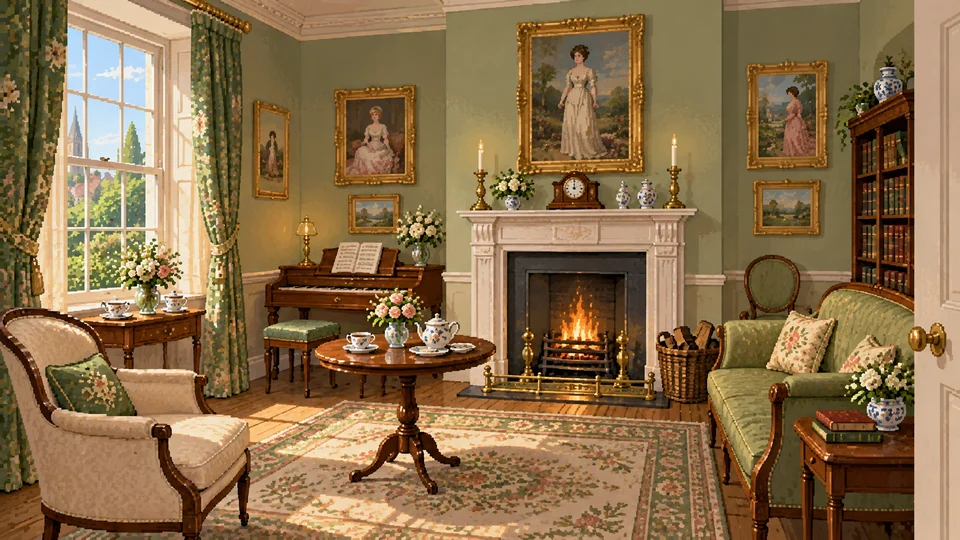
“Is not this room rich in specimens of your landscapes and flowers; and has not Mrs. Weston some inimitable figure-pieces in her drawing-room, at Randalls?”Emma · chapter 6
Inside the house
The walls display Emma’s landscapes and Mrs. Weston’s figure pieces.
Original passage
An illustration combining details from Austen’s descriptions.
“Let me entreat you,” cried Mr. Elton; “it would indeed be a delight! Let me entreat you, Miss Woodhouse, to exercise so charming a talent in favour of your friend. I know what your drawings are. How could you suppose me ignorant? Is not this room rich in specimens of your landscapes and flowers; and has not Mrs. Weston some inimitable figure-pieces in her drawing-room, at Randalls?”
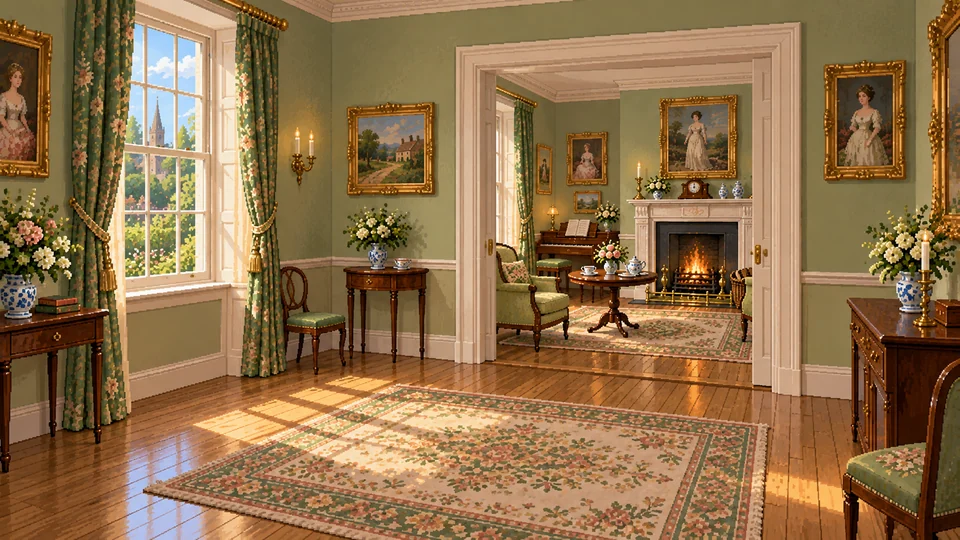
“taking the dimensions of the other parlour, in the hope of discovering, in spite of all that Mr. Weston could say of their exactly equal size, that it was a little the largest”Emma · Volume II, chapter 11
Paired parlours
The passage tests whether one of Randalls’ equal parlours can hold dancing.
Original passage
Illustrated from this passage.
Frank Churchill had danced once at Highbury, and longed to dance again; and the last half-hour of an evening which Mr. Woodhouse was persuaded to spend with his daughter at Randalls, was passed by the two young people in schemes on the subject. Frank’s was the first idea; and his the greatest zeal in pursuing it; for the lady was the best judge of the difficulties, and the most solicitous for accommodation and appearance. But still she had inclination enough for shewing people again how delightfully Mr. Frank Churchill and Miss Woodhouse danced—for doing that in which she need not blush to compare herself with Jane Fairfax—and even for simple dancing itself, without any of the wicked aids of vanity—to assist him first in pacing out the room they were in to see what it could be made to hold—and then in taking the dimensions of the other parlour, in the hope of discovering, in spite of all that Mr. Weston could say of their exactly equal size, that it was a little the largest.